
Uzbekistan's Fertilizer Exports to India Anchor a Complementary Trade Relationship
Uzbekistan's fertilizer exports to India are becoming an important part of a broader trade relationship in which the two countries bring different strengths to the table. India is a major pharmaceutical and chemical supplier to Uzbekistan, while Uzbekistan provides fertilizers, minerals and other resource-linked products to the Indian market. With bilateral trade reaching about $1.3 billion in 2025 and both governments targeting $5 billion by 2030, fertilizer trade offers a practical example of how the relationship can become more balanced and strategically complementary.
India and Uzbekistan are entering a new phase of economic cooperation.
The two countries recently elevated their relationship to a Comprehensive Strategic Partnership and established an ambitious target of reaching $5 billion in bilateral trade by 2030. The governments have also identified market access, connectivity, banking and payment systems as areas that need to improve to achieve that goal.
Within this expanding relationship, fertilizers occupy a particularly interesting position.
India has a structural requirement for imported fertilizers.
Uzbekistan has fertilizer production capacity and is already supplying urea to India.
That creates a straightforward commercial relationship:
Uzbekistan → Fertilizers
India → Pharmaceuticals, chemicals and manufactured goods
The relationship therefore has the potential to develop beyond conventional export growth into a two-way industrial supply chain.
Uzbekistan Is Already a Meaningful Urea Supplier to India
The latest trade data provides a clear indication of the relationship's scale.
In 2025, India imported approximately 84.68 million kilograms of urea from Uzbekistan, valued at about $38.53 million. Uzbekistan ranked among India's significant nontraditional urea suppliers that year.
Across the broader fertilizer category, India's imports from Uzbekistan reached approximately $46.87 million in 2025.
That makes fertilizers one of the largest individual product categories in India's imports from Uzbekistan.
The numbers are still small compared with India's overall fertilizer import bill.
But strategically, they matter.
India's Fertilizer Market Depends Heavily on Imports
India is one of the world's largest agricultural markets.
Domestic fertilizer production is substantial, but it does not completely satisfy national demand.
Government data shows the scale of India's import dependence.
During April–January of fiscal year 2025–26, India imported approximately:
89.30 million tonnes of urea
60.16 million tonnes of DAP
while domestic production during the same period stood at approximately 251.26 million tonnes of urea and 33.71 million tonnes of DAP.
This makes imported fertilizer an important component of India's agricultural supply chain.
For procurement teams, supplier diversification therefore has strategic value.
Uzbekistan Offers Another Source of Urea
India's largest fertilizer suppliers remain countries such as Russia, Saudi Arabia, China, Morocco and Oman. In 2025, India's total fertilizer imports were valued at roughly $14.17 billion, with Uzbekistan contributing about $46.87 million.
Uzbekistan is therefore not replacing India's major suppliers.
Instead, it is providing another source.
That distinction is important.
In a volatile fertilizer market, even relatively modest additional supply can provide procurement flexibility.
Supplier Diversification Matters More During Market Disruptions
Fertilizer markets are vulnerable to geopolitical and energy shocks.
Production costs can change rapidly because nitrogen fertilizers are closely linked to natural-gas economics.
International trade can also be affected by:
Sanctions
Export restrictions
Shipping disruptions
Energy-price spikes
Currency movements
Port congestion
A buyer that relies on only a few major origins can therefore face significant procurement risk.
Adding Uzbekistan to the supplier portfolio can provide another option.
Urea Has a Special Strategic Role
Urea is particularly important because it is one of India's most widely used nitrogen fertilizers.
Its supply chain is closely connected to natural gas and ammonia.
The production chain broadly follows:
Natural Gas
↓
Hydrogen
↓
Ammonia
↓
Urea
This means fertilizer availability depends not only on agricultural demand but also on energy markets.
For India, sourcing urea from multiple production regions can therefore reduce exposure to a single energy or geopolitical corridor.
Uzbekistan's Position in the Regional Fertilizer Market
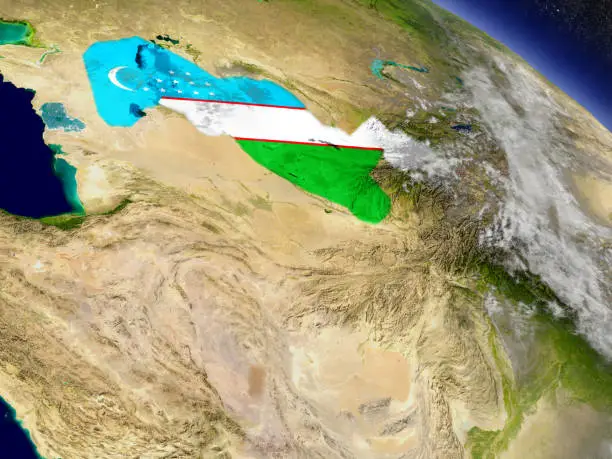
Uzbekistan is geographically located in the heart of Central Asia and has an established fertilizer industry.
Its producers serve domestic agriculture as well as export markets.
In 2025, Uzbekistan exported urea to several major destinations.
The European Union imported approximately $99.3 million of Uzbek urea, while Brazil imported around $43.7 million. India's imports were approximately $38.5 million.
This demonstrates that Uzbekistan is already connected to international fertilizer markets.
India is therefore not creating the export relationship from scratch.
It is expanding an existing trade channel.
Fertilizer Trade Helps Balance the Bilateral Relationship
The broader India-Uzbekistan trade structure is heavily weighted toward Indian exports.
In 2025, Uzbekistan reported approximately:
$1.15 billion of imports from India
against
$164.6 million of exports to India.
Total bilateral trade reached around $1.3 billion, up 33.3% from the previous year.
This imbalance is significant.
It means Uzbekistan has an incentive to increase exports to India as bilateral trade expands.
Fertilizers provide one practical route.
Fertilizers Are Part of a Larger Uzbek Export Basket
India's imports from Uzbekistan are not limited to fertilizers.
The broader basket includes:
Precious metals
Ores
Copper
Fertilizers
Plant-based products
Resins
Industrial materials
In 2025, fertilizer imports represented approximately $46.87 million of India's $208.69 million total imports from Uzbekistan in UN Comtrade-based data.
That places fertilizers among Uzbekistan's more important export categories to India.
The Relationship Is Complementary Rather Than Competitive
This is perhaps the most interesting feature of the bilateral relationship.
India and Uzbekistan are not necessarily competing for the same export markets.
Instead, their industrial strengths can complement each other.
India provides:
Pharmaceuticals
Chemicals
Engineering products
Healthcare products
Services
Uzbekistan provides:
Fertilizers
Minerals
Metals
Agricultural products
Resource-linked materials
This creates a natural basis for two-way trade.
Pharmaceutical and Fertilizer Trade Can Grow Together
The relationship becomes particularly interesting when pharmaceuticals and fertilizers are considered together.
India already identifies pharmaceutical products among its major exports to Uzbekistan. India's Ministry of External Affairs also lists fertilizers among the major products imported from Uzbekistan.
The resulting trade pattern is:
Indian pharmaceutical and chemical manufacturing
↕
Uzbek fertilizer and resource supply
This is more strategically balanced than a relationship dominated by a single commodity.
India's Fertilizer Procurement Strategy Is Changing
India's fertilizer procurement has increasingly emphasized supply security.
Government data shows fertilizer imports rising significantly in fiscal 2025–26 as domestic production did not fully cover requirements.
That environment creates opportunities for additional suppliers.
Uzbekistan does not need to become India's largest fertilizer source.
It only needs to remain a reliable incremental supplier.
Reliability May Matter More Than Volume
For fertilizer procurement, a supplier's strategic value is not determined only by annual tonnage.
Buyers also evaluate:
Reliability
Delivery schedules
Quality consistency
Pricing
Contract flexibility
Port access
Payment terms
Political risk
A supplier providing predictable deliveries during a tight market can be more valuable than a supplier offering a lower nominal price but uncertain availability.
Landlocked Geography Is a Challenge
Uzbekistan's biggest disadvantage is also obvious:
It is landlocked.
Fertilizer exports to India therefore require complex multimodal logistics.
The supply chain can involve:
Uzbekistan
↓
Rail / Road
↓
Transit country
↓
Port
↓
Ocean freight
↓
Indian port
↓
Inland distribution
Every additional stage can increase cost and complexity.
Freight Economics Will Determine Competitiveness
The relevant procurement calculation is not simply:
Uzbek urea price
It is:
Urea price + Inland transport + Transit costs + Port handling + Ocean freight + Insurance + Indian inland logistics
This is the product's landed cost.
If Uzbek urea is competitively priced at origin but expensive to transport, its market share may remain limited.
But Geography Can Also Create Strategic Value
The long logistics chain does not automatically eliminate the opportunity.
India already imports fertilizer from distant origins.
Russia, Morocco, Saudi Arabia, Oman and other suppliers demonstrate that long-distance fertilizer trade is commercially viable when the economics work.
The question is therefore not:
"Is Uzbekistan too far away?"
It is:
"Can Uzbek fertilizer reach India at a competitive delivered cost?"
Central Asian Connectivity Could Become More Important
Improved India-Central Asia connectivity could strengthen the economics of this trade.
The recent India-Uzbekistan strategic partnership specifically identifies connectivity as an area where the countries intend to make progress.
For fertilizer exporters, better connectivity could mean:
Lower transit costs
More predictable delivery
Reduced border delays
Better multimodal coordination
Greater shipment reliability
That could make Uzbek fertilizer more competitive in India.
Payment Systems Also Matter
The two countries have identified banking and payment systems as another area requiring improvement.
For commodity trade, payment infrastructure can have a direct impact on transaction costs.
Fertilizer deals can involve large values and tight delivery schedules.
Efficient cross-border payments can therefore reduce friction for both buyers and sellers.
India's Buyers Need More Than a Competitive Quote
For an Indian fertilizer buyer, an Uzbek supplier needs to demonstrate more than a favorable FOB price.
The buyer should evaluate:
Origin price
Freight
Transit risk
Delivery reliability
Payment conditions
Quality
Regulatory compliance
This determines the true commercial value.
The Energy Link Cannot Be Ignored
Urea production is highly energy-intensive.
That makes natural-gas prices one of the most important variables in global nitrogen fertilizer economics.
When gas prices rise:
Production cost rises
↓
Urea prices rise
↓
Import costs rise
↓
Agricultural input costs increase
Uzbek producers therefore compete not only on manufacturing efficiency but also on their access to competitive energy.
Global Fertilizer Markets Remain Vulnerable
India's dependence on imports makes it sensitive to international fertilizer disruptions.
Recent global events have demonstrated how quickly fertilizer markets can be affected by:
Energy disruptions
Geopolitical conflicts
Export controls
Shipping problems
Production outages
A diversified origin portfolio is consequently valuable even when some suppliers are more expensive than others.
Uzbekistan Could Increase Its Strategic Importance
The current trade value is relatively modest.
But bilateral trade does not need to remain at today's level.
The governments have established a $5 billion bilateral trade target for 2030.
If that target is pursued seriously, fertilizer exports could become one component of a much larger commercial relationship.
Potential expansion areas include:
Urea
Other nitrogen fertilizers
Phosphate products
Specialty fertilizers
Agricultural inputs
Chemical intermediates
The actual mix will depend on production economics and market access.
India's Own Fertilizer Exports Are Growing Too
Interestingly, India is also increasing its fertilizer exports, although it remains overwhelmingly a net importer.
Indian fertilizer exports rose from approximately 317,515 tonnes in FY2023–24 to 479,737 tonnes in FY2025–26, according to official data reported by Business Standard.
This illustrates the complexity of the fertilizer market.
India can simultaneously:
Import large quantities of fertilizer
and
Export selected fertilizer products.
Trade flows depend on product type, geography, pricing and market demand.
This Opens the Door to More Complex Trade
India-Uzbekistan fertilizer trade could eventually evolve beyond simple one-way shipments.
For example:
Uzbek raw materials / fertilizer inputs
→
Indian chemical processing
→
Finished agricultural products
Such value-chain integration would create more economic value than commodity trade alone.
Specialty Agricultural Inputs Could Be the Next Step
Once commercial relationships are established around bulk fertilizer, companies may explore higher-value products.
These could include:
Micronutrients
Water-soluble fertilizers
Specialty blends
Biostimulants
Crop nutrition products
Agricultural chemicals
These products can have higher margins and lower value-to-weight constraints than bulk commodities.
That could make them more attractive for long-distance trade.
Indian Chemical Companies Could Also Find Opportunities
The relationship is not limited to fertilizer traders.
India's chemical sector has significant capabilities in:
Specialty chemicals
Agricultural chemicals
Pharmaceutical intermediates
Industrial chemicals
India's government has identified chemicals among the major drivers of its export growth in 2026.
This gives Indian chemical companies an opportunity to expand their presence in Uzbekistan while Uzbek fertilizer companies expand in India.
A Two-Way Agricultural-Chemical Corridor Could Emerge
The longer-term opportunity can be visualized as:
Uzbekistan
Fertilizers + Minerals
↓
India
Chemical + Pharmaceutical Manufacturing
↓
Uzbekistan
Pharmaceuticals + Specialty Chemicals
This creates a circular trade relationship rather than a simple one-way export model.
Procurement Teams Should Monitor Four Variables
Indian fertilizer buyers considering Uzbekistan should closely track:
1. Landed cost
Is Uzbek fertilizer competitive after logistics?
2. Availability
Can suppliers maintain reliable shipment schedules?
3. Transit routes
Are new connectivity initiatives reducing logistics friction?
4. Contract flexibility
Can suppliers respond to India's seasonal demand?
These variables will determine whether Uzbekistan's role expands.
What Would Make Uzbek Fertilizer More Competitive?
Several developments could improve the economics.
Better rail connectivity
→ Lower inland transportation costs
Faster border clearance
→ Shorter transit times
More efficient ports
→ Lower handling costs
Improved payment systems
→ Lower transaction friction
Long-term contracts
→ Greater supply predictability
Higher production efficiency
→ More competitive fertilizer prices
Together, these factors could strengthen Uzbekistan's position in the Indian market.
The $5 Billion Target Provides a Larger Strategic Framework
The fertilizer relationship should therefore be viewed within the broader bilateral trade target.
India and Uzbekistan are no longer discussing only incremental trade growth.
They are building a wider economic partnership covering:
Trade
Investment
Infrastructure
Agriculture
Pharmaceuticals
Critical minerals
Energy
Digital infrastructure
Connectivity
The fertilizer relationship fits naturally into this broader framework.
Conclusion
Uzbekistan's fertilizer exports to India may represent only a small fraction of India's enormous fertilizer import market, but their strategic significance is larger than the headline numbers suggest.
In 2025, India imported approximately $46.87 million of fertilizers from Uzbekistan, including roughly $38.53 million of urea, equivalent to about 84.68 million kilograms.
At the same time, India's total fertilizer imports were worth approximately $14.17 billion, demonstrating that Uzbekistan currently remains a supplementary rather than dominant supplier.
That is precisely why the relationship is interesting.
Uzbekistan does not need to displace India's largest fertilizer suppliers.
It can provide additional diversification.
India, meanwhile, offers Uzbekistan a large and growing market for fertilizers while exporting pharmaceuticals, chemicals, engineering products and other manufactured goods in the opposite direction. India's official country brief already identifies pharmaceuticals among its major exports to Uzbekistan and fertilizers among its major imports.
The two countries' decision to target $5 billion in bilateral trade by 2030 could give this complementary structure considerably more momentum.
The biggest constraint will be logistics.
Uzbekistan's landlocked geography means freight, transit routes and border efficiency will determine whether its fertilizer exports can compete effectively with India's established suppliers.
If connectivity improves and payment and market-access barriers are reduced, Uzbekistan could become a more meaningful secondary fertilizer origin for India.
For procurement teams, the opportunity is not simply about finding another source of urea.
It is about building a more diversified fertilizer supply portfolio.
And for the two countries, the larger opportunity is even broader:
Uzbek fertilizer and resource exports can help balance India's pharmaceutical and chemical exports, creating a more complementary India–Uzbekistan trade relationship as both countries work toward the $5 billion 2030 target.
Acesulfame Potassium (E950) CAS: 55589-62-3